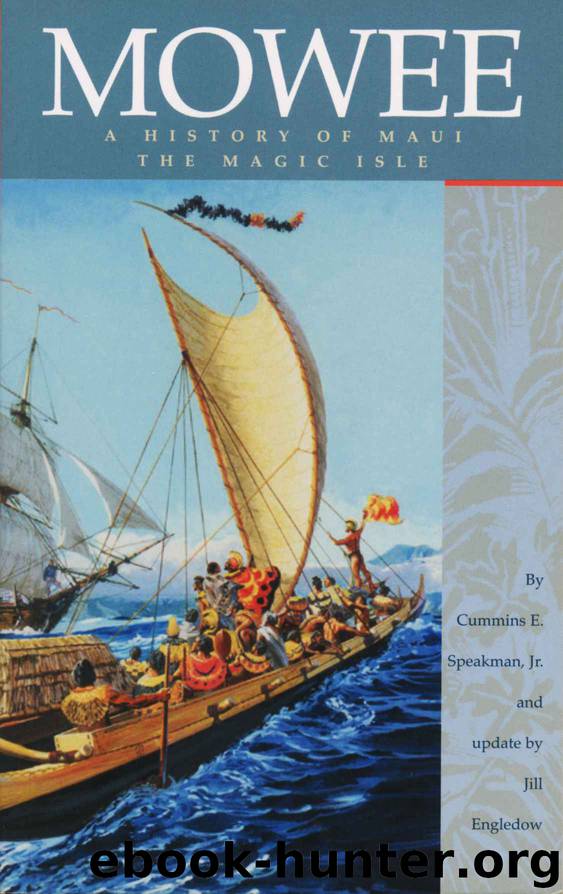
Mowee: A History of Maui, The Magic Isle by Cummins E. Speakman Jr. & Jill Engledow
Author:Cummins E. Speakman Jr. & Jill Engledow
Language: eng
Format: mobi
Publisher: Mutual Publishing, LLC
Published: 2001-10-01T07:00:00+00:00
The Catholics
It is said that the first Mass was held on Maui in January 1841 at the home of one Joaquin Armas, a cowboy who worked for King Kamehameha III.
Though strongly opposed by the Protestant missionaries and by the chiefs, especially Queen Regent Ka-‘ahu-manu, the Catholics gradually became established on Maui. One local legend has it that the faith was propagated by sailors from a shipwrecked Spanish galleon in the sixteenth century. However, the first known Catholic priest at Lahaina arrived in 1846 and quickly found a large following on the island.
Early converts were Helio and Petero, brothers from Wailua and Wailuku. Helio was baptized in Honolulu and returned to Maui to travel about preaching the Roman Catholic faith. He became known as “The Apostle of Maui” and died at Wailua between Hana and Kaupo where his grave below a peak in the center of Wailua gulch is marked by a twenty-foot cross of concrete. The Maria Lanikula Church was built in 1858 at Lahaina.
One of the most interesting stories of the Catholics on Maui is that of the march from the Kaupo-Kipahulu districts all the way to Wailuku when the judge at Wailuku ordered the Catholics to be arrested. The men who were deputised to arrest and bring them to trial in Wailuku tied them together with ropes and marched them along the Pi‘ilani Highway through all the districts of Hana and Nahiku, Kaenae, Kailua, Haiku, and Paia.
They were led by Helio and his brother, and as they went along they were joined by others on the long march to Wailuku. By the time they reached Wailuku there were several hundred–too many, indeed, to be tried, and the judge at Wailuku dismissed the case. Petero and Helio and the others made their way back along the highway, preaching as they went.
The journey of the captive Catholics from Kahiki-nui, Kaupo and Hana, which took more than a month, was called the paakaula (“the tying with ropes”). The result was the tripling of the number of catechumens on Maui, then over a thousand. The Edict of Toleration by Kamehameha III at Lahaina on June 17, 1839, gave religious freedom to his people, and the first Catholic catechism, the Vahi Katekimo, was published in Honolulu in 1847.
St. Anthony’s Church, a stone edifice, replaced an earlier frame structure at Wailuku. It was blessed by Bishop Maigret on May 3, 1873. After Mass, the Bishop expressed the hope that one of the priests would volunteer to help the lepers on Moloka‘i. Father Damien answered the call and, in time, became the “fellow leper of my little flock.” St. Anthony’s Church was destroyed by fire on November 1, 1977, and a new structure was built in its place.
Download
This site does not store any files on its server. We only index and link to content provided by other sites. Please contact the content providers to delete copyright contents if any and email us, we'll remove relevant links or contents immediately.
| Africa | Americas |
| Arctic & Antarctica | Asia |
| Australia & Oceania | Europe |
| Middle East | Russia |
| United States | World |
| Ancient Civilizations | Military |
| Historical Study & Educational Resources |
Cat's cradle by Kurt Vonnegut(15466)
Pimp by Iceberg Slim(14708)
4 3 2 1: A Novel by Paul Auster(12539)
Underground: A Human History of the Worlds Beneath Our Feet by Will Hunt(12170)
The Radium Girls by Kate Moore(12110)
Wiseguy by Nicholas Pileggi(5870)
The Fire Next Time by James Baldwin(5536)
Perfect Rhythm by Jae(5492)
American History Stories, Volume III (Yesterday's Classics) by Pratt Mara L(5348)
Paper Towns by Green John(5262)
Pale Blue Dot by Carl Sagan(5096)
A Higher Loyalty: Truth, Lies, and Leadership by James Comey(5030)
The Doomsday Machine by Daniel Ellsberg(4574)
The Mayflower and the Pilgrims' New World by Nathaniel Philbrick(4565)
Killers of the Flower Moon: The Osage Murders and the Birth of the FBI by David Grann(4496)
The Sympathizer by Viet Thanh Nguyen(4459)
Too Much and Not the Mood by Durga Chew-Bose(4404)
The Borden Murders by Sarah Miller(4402)
Sticky Fingers by Joe Hagan(4268)
